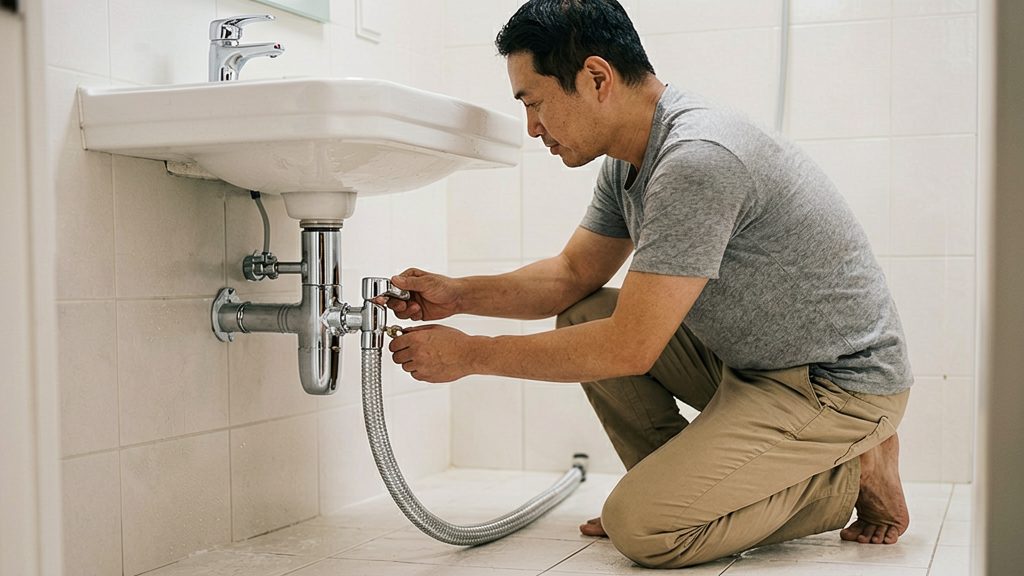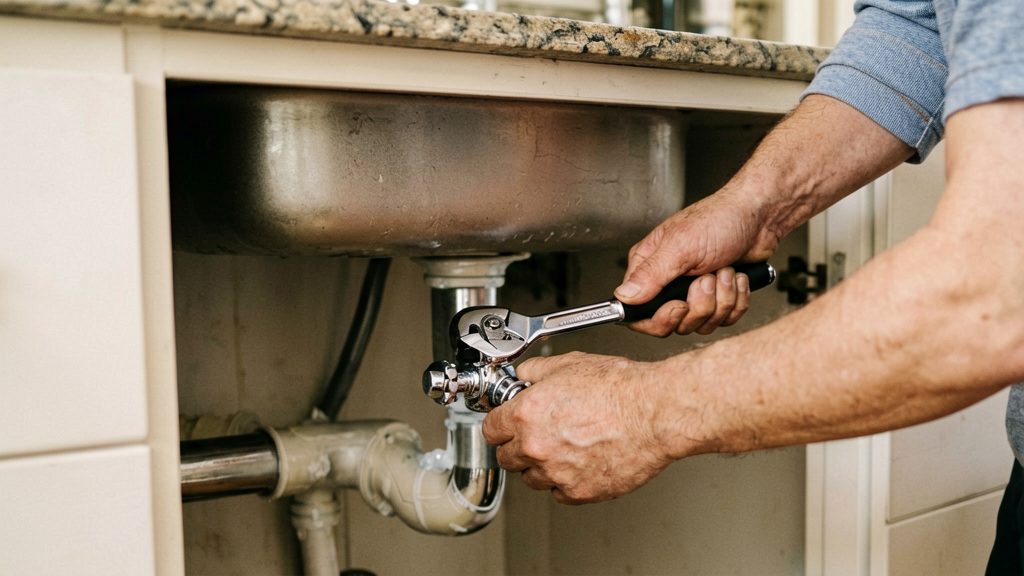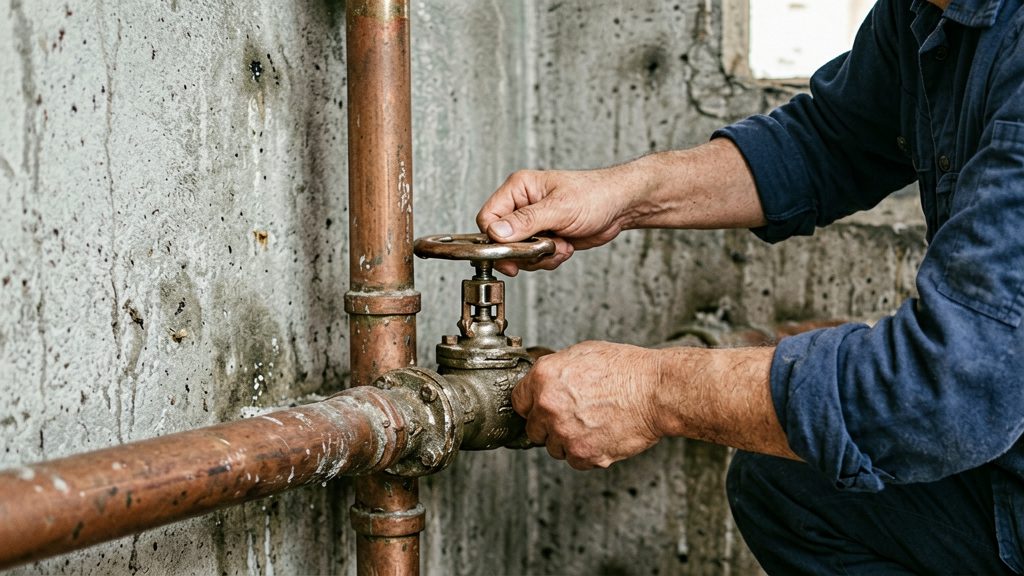
The main shutoff valve is usually where the water line enters the house. Finding the valve before an emergency means you can stop the flow quickly when a pipe bursts or a fixture leaks. Layouts vary, so follow the supply line from the wall where water enters the home.
Where is your main water shutoff valve?
Common spots inside the home
- Basement: Look near the wall where the cold-water line enters, often close to the water heater or utility area.
- Garage: In homes with an attached garage, the valve may sit on the wall that shares a boundary with the house.
- Laundry room: The supply line often runs through this room to reach the washing machine, so the main valve may be nearby.
- Crawl space: Access is usually through a panel or hatch. The valve may be exposed or near the entry point.
If none of these areas yields a valve, follow the cold-water pipe from the water heater or a visible fixture back toward the wall where it enters the house.
Valve location relative to the meter
The water supply runs from the street, through the meter valve, and into the house. Some homes have a shutoff valve at or near the meter outside, and a second valve inside after the line enters. Check both locations, since the valve you find first may not be the one that stops all water to the home. Whether you may operate a meter valve depends on your local water provider’s rules, so check those rules before touching it.
Labelling the valve
Lakehaven Water and Sewer District advises that you label the main shutoff valve so it can be found quickly in an emergency. Use a durable tag or write directly on a nearby surface. Keep the area around the valve clear of storage, and tell everyone in the household where it is.
For rentals, the valve may be controlled by the landlord or property manager or placed in a shared area. Ask before assuming you have access.
The table below summarises the supported steps, with each one attributed to its publisher. Local rules and valve condition can change the procedure.
| Step | Action | Source |
|---|---|---|
| Locate the valve | Check the basement, garage, laundry room or crawl space. Label the valve once found so it can be located quickly in an emergency. | City of Kirkland; Lakehaven Water and Sewer District |
| Identify the valve type | A straight lever handle indicates a ball valve. A wheel handle indicates a gate valve. | City of Kirkland |
| Close the valve | Gate valve: turn the handle clockwise. Ball valve: turn the handle perpendicular to the pipe. Excessive force on a gate valve can damage it. | Middlesex Water Company; Lakehaven Water and Sewer District |
| Relieve pressure and confirm shutoff | Open a sink or tub faucet on the highest level, as that guidance specifies, and check that water stops. | Middlesex Water Company |
| Stop if the valve will not turn | If the valve cannot be operated by hand, call a licensed plumber, because older valves may be corroded or damaged. | Middlesex Water Company |
| Restore water | Open the main valve slowly, allow pressure to equalise, and bleed air from faucets. | Middlesex Water Company |
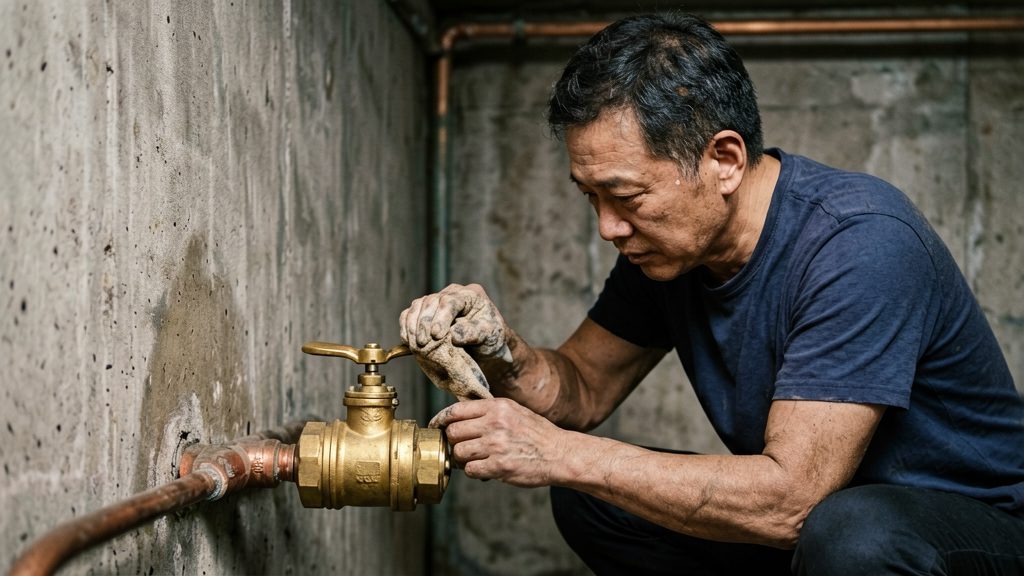
Which type of valve do you have?
Most main shutoff valves are either ball valves or gate valves, and the handle is the quickest way to tell them apart. Identify the type before you operate the valve, because the two designs are handled differently.
Once you have located it, check the handle:
- Straight lever handle: A straight lever can identify a ball valve (City of Kirkland). Its handle moves through a short arc between its open and closed positions.
- Wheel handle: A wheel handle can identify a gate valve (City of Kirkland).
If the handle matches neither style, look for markings on the valve body or contact a licensed plumber before you turn it.
How to close the main water valve
Closing the main valve starts with identifying the valve type, because the two common designs are turned in different ways.
Gate valves
A gate valve has a wheel-style handle. To close it, turn the handle clockwise until it stops. Turn it steadily and stop when it reaches the end of its travel.
Ball valves
A ball valve has a straight lever handle. To close it, turn the handle so it sits perpendicular to the pipe. The lever is in line with the pipe when the valve is open, so a quarter turn to a crosswise position shuts off the flow. Middlesex Water Company gives the perpendicular-to-pipe closing direction.
Avoid excessive force
Check that the water has stopped
After closing the main valve, confirm that water has actually stopped before you start work. The main check is to open a faucet on the highest outlet in the house and see whether water keeps flowing. Middlesex Water Company recommends this test to relieve pressure and verify the supply has stopped.
Open the highest faucet
Go to the highest sink, shower, or tub faucet in the building, usually on an upper floor, and open it fully. Water should run briefly as the pipes drain, then slow and stop. If it keeps running steadily, the valve is not fully closed, or you have closed a different valve from the one that feeds the house.
Check each fixture for residual flow
Open every remaining cold and hot tap in turn, and flush each toilet once. A toilet that refills its tank after flushing is still receiving water. Note which fixtures you tested, and confirm that each one produces no water. Test hot and cold taps separately, because hot water already stored in the water heater can run out for a short time after the supply is closed.
Watch for drips after the faucet runs dry
Leave the test faucet open and check that the flow stops. Drips after closing a faucet can come from water remaining in the spout, so they do not by themselves show that the main shutoff valve is passing water. If flow continues with the test faucet open after residual water has drained, stop work and contact a licensed plumber. Recheck the valve position, then look under the sinks and around the toilet base for moisture. If water still appears, the valve may not be fully closed, or there may be a leak further along the line.
What if the valve will not turn?
A main valve that resists turning is often an older valve. According to Middlesex Water Company, older household water valves may be corroded or damaged, which can stop the handle from moving freely or stop the valve from sealing. You cannot confirm this from the handle alone, so treat a stiff valve as unreliable until a plumber has inspected it.
Handle type helps you identify the valve, but not its condition.
If the valve will not move by hand, take these steps:
- Stop operating it. Do not use tools or added leverage to free it.
- Check whether water is still flowing. After closing the valve, open a faucet and confirm the supply has stopped, as Middlesex Water Company advises. If water keeps running, the valve is not closing fully.
- Call a licensed plumber if the valve cannot be operated by hand. Middlesex Water Company advises this because the valve may be corroded or damaged.
- Tell the plumber whether the valve was stiff, partly closed, or leaking when you tried to shut it, so they can assess the valve and any repair or replacement.
When to call your water utility
Whether you may operate a valve on the utility side of the water meter depends on local rules. City of Kirkland and Lakehaven Water and Sewer District describe customer operation of the main shutoff, but other areas may limit access to particular meter valves. Ask your utility which valves you are allowed to operate before you touch any valve outside your home.
If water is leaking at the meter, at the connection between the meter and the service line, or from a valve on the utility side, do not try to repair it yourself. Contact your utility to report the leak and confirm who is responsible for the affected pipe, valve, or connection; responsibility depends on local service arrangements and the meter location.
If you do not recognise the main valve or have never operated it, call the utility before turning it. Do not force an unfamiliar valve.
How to turn the water back on
Open the main valve slowly, so pressure builds gradually in the pipes instead of surging into fixtures. According to Middlesex Water Company, this lets pressure equalize throughout the system before you start using water.
Open the main valve gradually
- Reverse the closing motion. For a gate valve, turn the handle counterclockwise. For a ball valve, move the lever back in line with the pipe.
- Turn slowly and stop once the valve is fully open. Do not force it.
Bleed trapped air from each faucet
Air enters the pipes while the system is empty, and it appears as sputtering or spitting from faucets. To clear it:
- Open a cold faucet fully and let it run until the flow is steady and free of air.
- Repeat with the hot faucet on the same fixture.
- Work through every faucet in the home, including tubs, showers, and outdoor taps.
- Close each faucet once its flow runs smoothly.
If a faucet still sputters or flows weakly after running, its aerator may be clogged with debris. Consult the faucet manufacturer’s instructions for cleaning it.
Check for leaks once water is restored
Inspect the areas most likely to leak after the system is pressurized:
- The main valve body and its packing nut
- Pipe joints and fittings, including those under sinks and behind toilets
- Connections to the water heater, washing machine, and dishwasher
Repeat the inspection after the system has run for a while. If a leak appears, close the main valve again and contact a licensed plumber for repair.
Brief closure of the main valve is not winterization. Before draining or refilling a water heater or boiler, check the appliance manufacturer’s instructions, since requirements differ by model.