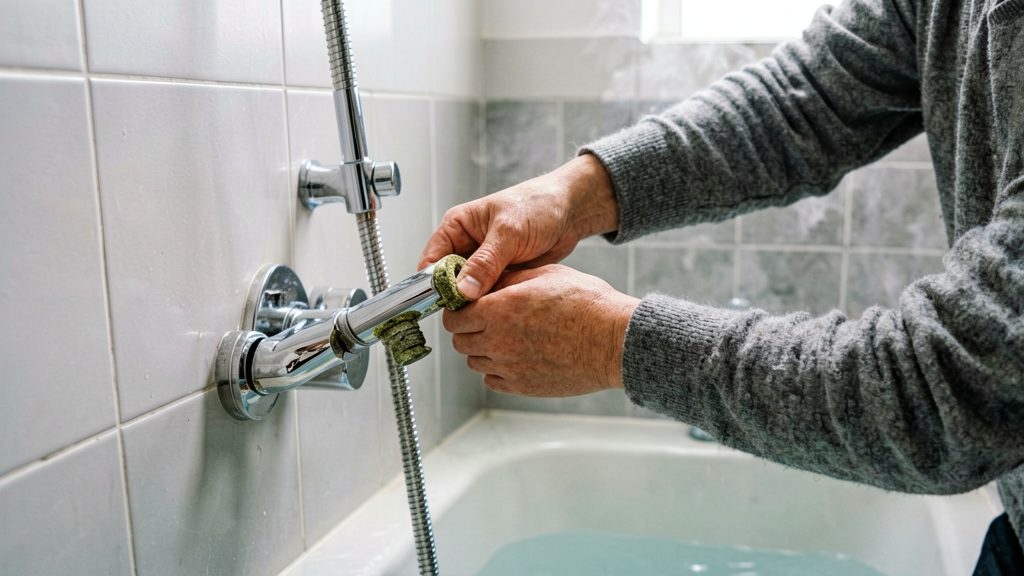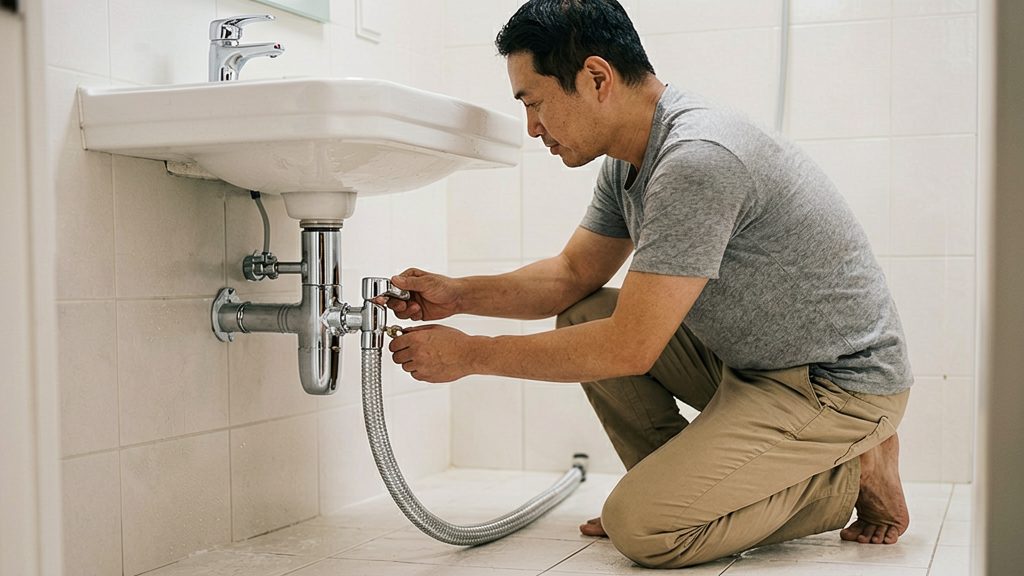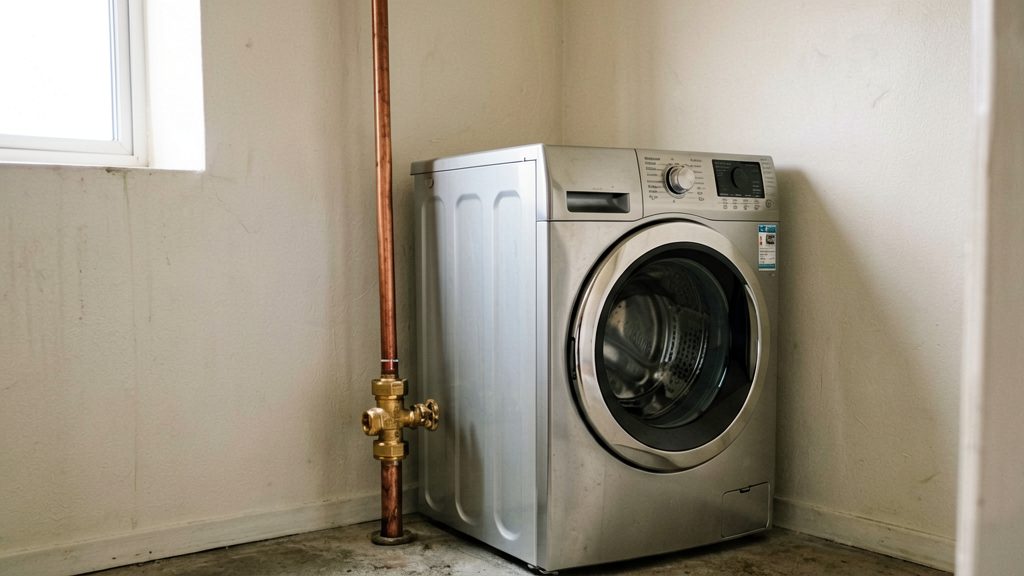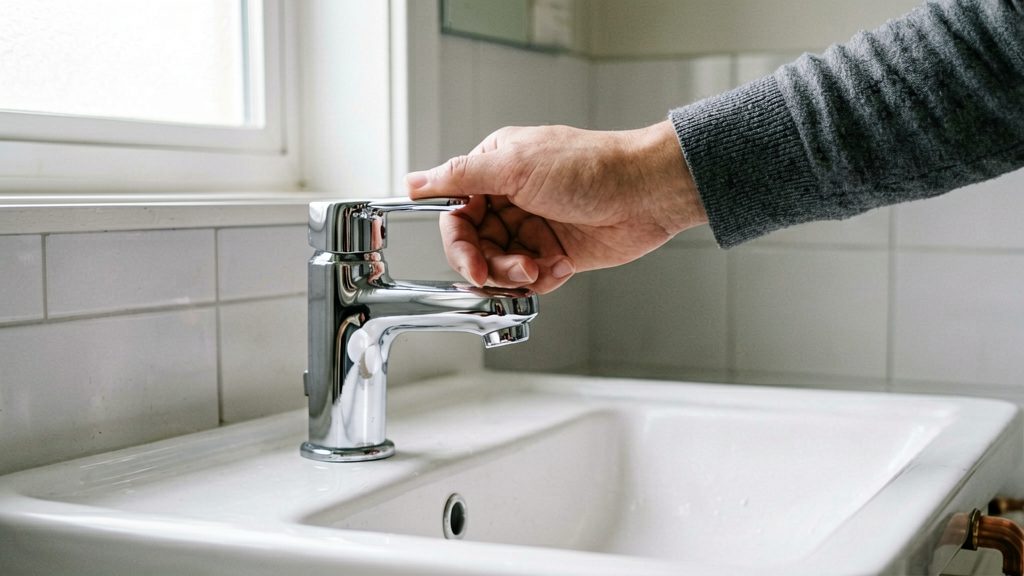
A bathroom faucet that knocks when you turn it on or off is often linked to water hammer. According to Oatey, water hammer is a pressure surge that occurs when moving water suddenly stops or changes direction, and it can produce banging in plumbing pipes. The same sound can have other sources, so water hammer is a likely explanation to test, not a confirmed diagnosis.
Why Does My Bathroom Faucet Knock?
How a pressure surge forms
Water in a supply line is moving under pressure. When a valve closes quickly, that moving column is halted, and its momentum turns into a sharp rise in pressure at the closed point. This rise is the pressure surge that defines water hammer.
Why sudden shut-off produces banging
The surge is what makes the noise. Oatey notes that unsecured supply pipes can move and strike surrounding surfaces during water hammer, which produces knocking or vibration. Repeated events can also wear components down: Sioux Chief Manufacturing (2022) reports that repeated water hammer can damage faucets, fittings, valves and pipe supports.
The pressure wave in plumbing
The surge does not stay at the valve. It travels along the pipe as a pressure wave that runs back and forth through the line:
- Water flows through the supply pipe.
- A valve closes or redirects the flow abruptly.
- The moving water’s momentum becomes a pressure spike at the closed point.
- The spike travels along the pipe, reflecting off fittings and bends, and weakens with each pass.
Because the wave moves through the pipe rather than staying at the faucet, the impact can be felt or heard away from the valve itself.
Is It Water Hammer or Valve Vibration?
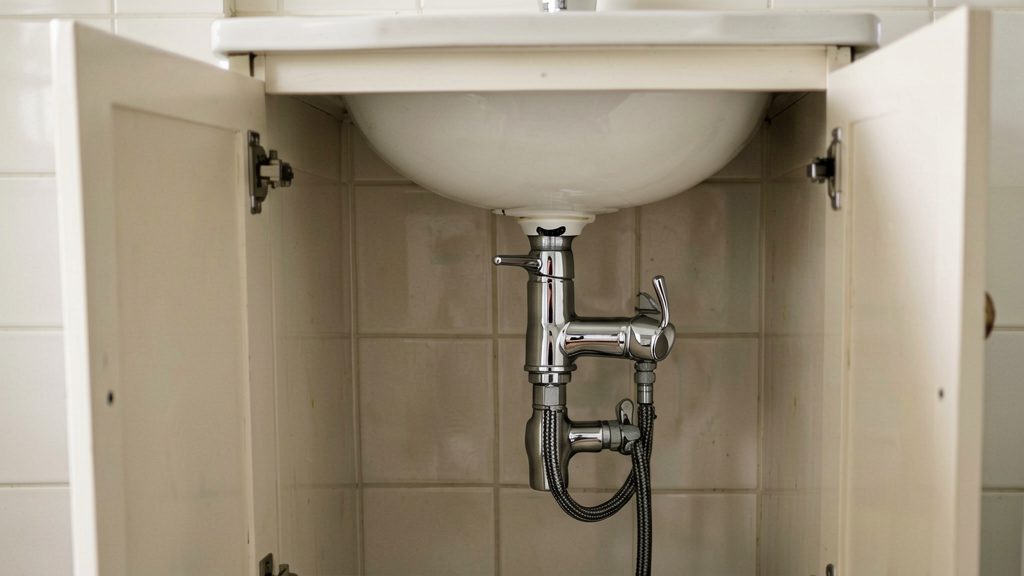
Both problems produce a knock, but they differ in when and where the noise appears. A knock tied to one tap can instead point to a loose internal valve, which Hunker (2022) describes as interrupting flow as the faucet opens. The noise pattern narrows the possibilities but does not confirm either cause on its own.
Noise Timing When Opening Versus Closing
Note exactly when the knock happens. Hunker (2022) broadly attributes knocking on opening to water hammer, while manufacturer explanations emphasize abrupt flow stoppage or direction changes. Use the pattern below as a starting point:
| Observation | What it suggests |
|---|---|
| Knock only when the tap opens, at one fixture | Possible loose internal valve in that faucet |
| Bang when the tap is shut off quickly | Water hammer from abrupt flow stoppage |
| Knock at several fixtures when any one is shut off | Pressure surge moving through the supply system |
Single Faucet Knocking Versus Whole-House Banging
If only one bathroom faucet knocks, a loose internal valve is one possibility, but the sound may also come from a nearby supply pipe. Banging heard at several outlets can suggest water hammer traveling through the supply system; neither pattern confirms the diagnosis.
Pinpoint When and Where It Knocks
The loudest point of a knock is not always its source. According to Oatey, a banging noise near a valve can come from an unsecured supply pipe inside the wall, which moves during water hammer and strikes surrounding surfaces. Record the pattern of the knock before you open anything, then trace the pipe.
Log the Trigger and Timing
Note exactly what you were doing when the knock happened: opening the faucet, closing it, switching between hot and cold, or a fixture closing elsewhere in the house. The moment of closing or switching is the most useful detail. Also note whether the knock happens every time or only sometimes.
Record which fixture knocks.
Test With Other Fixtures Running
Run these tests in order and record the result of each:
| Test | What to record |
|---|---|
| Open and close the suspect faucet alone | Whether the knock follows the faucet action |
| Run a kitchen tap or flush a toilet, then operate the bathroom faucet | Whether the knock appears, changes or stops while another fixture draws water |
| Run a washing machine or dishwasher, then operate the bathroom faucet | Whether the knock changes while a large appliance is drawing water |
Record whether the knock changes when another fixture draws water. This observation can help a plumber investigate, but a changed or unchanged sound does not establish whether the cause is inside the faucet or elsewhere in the supply system.
Trace the Pipe
Where the pipes are exposed under the sink or along an accessible wall, trigger the knock and watch for movement. Look for supply lines that shift, rattle or touch a stud, joist or nearby surface. Do not open walls to look for pipes; if the pipe is hidden, the log and the tests above are the practical limit of a home check.
Your log narrows the possibilities, but on its own it does not confirm the cause of the knock.
Check Visible Pipes and Water Pressure
Unsecured supply pipes are the first external cause to check. According to Oatey, properly supporting and cushioning the pipes can prevent contact with surrounding surfaces.
Inspect the exposed runs under the sink and along the wall behind the fixture. Look for pipes that are not clamped to framing, pipes resting against studs, joists, or other pipes, and bare metal touching a hard surface. Add pipe straps where a run is loose, and place cushioning material between a pipe and any surface it strikes.
Measure the Incoming Water Pressure
Incoming water pressure is the second external factor. According to Oatey, incoming pressure should be evaluated, and a pressure-reducing valve installed if it exceeds 80 psi, to reduce the possibility of water hammer damage. Treat 80 psi as the point at which to act, not as a target. Check the reading with a pressure gauge threaded onto an outdoor hose bib or a laundry tap, and take the reading while no other fixture is running.
A high reading is worth addressing even if the knocking is intermittent.
Pressure-Reducing Valve Considerations
A pressure-reducing valve sits on the main supply and lowers pressure for the whole home, so its installation affects every fixture. Keep these points in mind:
- Have a licensed plumber confirm the reading and fit the valve, since it works on the main supply line.
- Match the valve’s flow direction to the arrow on its body and to the manufacturer’s instructions.
- Re-check the pressure after installation with the gauge, and confirm the valve’s rated range on its product label.
Repair the Faucet Valve
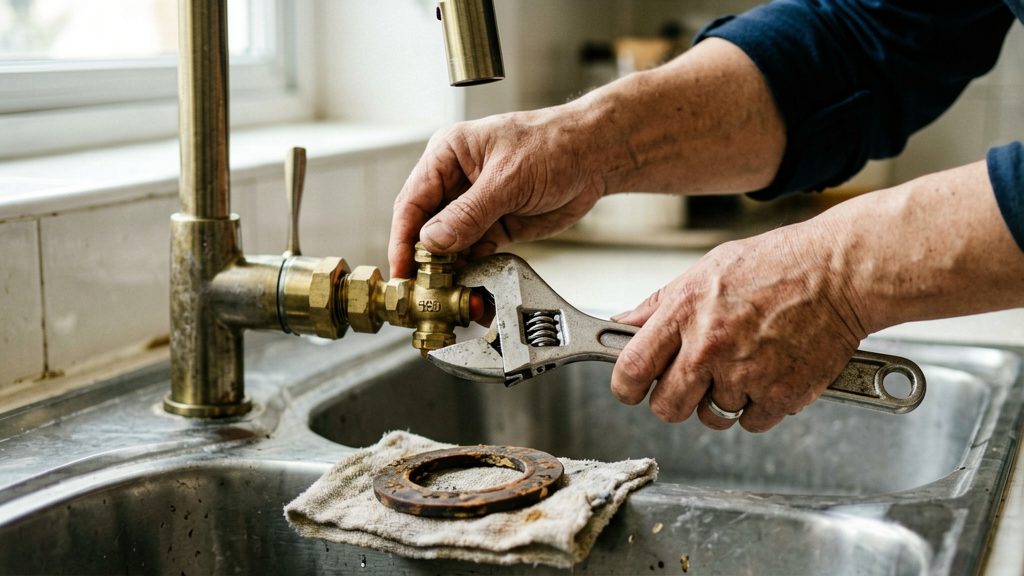
According to Hunker (2022), servicing the faucet or replacing the valve may resolve the knock. Worn washers and cartridges are not confirmed as a cause of this exact noise, so treat the steps below as a practical repair and check, not a guaranteed fix.
Shut Off the Supply
- Close the hot and cold shutoff valves under the sink, turning them clockwise until they stop.
- Open the faucet to drain the remaining water and pressure from the lines.
- Place a towel and a small container under the work area to catch residual water.
Remove and Inspect the Cartridge
- Remove the handle. Many handles hide a set screw under a decorative cap.
- Remove the retaining clip or nut that holds the cartridge, then pull the cartridge straight out. Note its orientation before removing it.
- Check the cartridge and the valve body for debris, mineral deposits, cracks and rough or stiff movement.
Replace Worn Parts
- Replace the cartridge if it is cracked, stiff or leaking, using an exact match for your faucet model.
- Replace the seals and washers included in the replacement kit. Old O-rings that are flattened or torn should not be reused.
- Apply only a lubricant the manufacturer recommends to seals.
Reassemble and Test
- Reinstall the cartridge in its original orientation, then secure the clip or nut and refit the handle.
- Open the shutoff valves slowly to avoid a sudden surge.
- Run the faucet on hot and cold through its full range of movement, and watch for knocking when it opens.
If the knocking returns, stop using the faucet until the cause is found. If the noise persists after a new cartridge is fitted, call a licensed plumber.
When a Water Hammer Arrester Helps
Sioux Chief Manufacturing (2022) describes a manufactured arrester as absorbing a pressure surge with a compressible air or gas cushion that stays permanently separated from the water. It addresses knocking that comes from the supply line, not from a fault inside the faucet.
Where an arrester fits and where it does not
| Situation | Source-backed response |
|---|---|
| Knocking from a sudden flow stop in the supply line | A manufactured arrester absorbs the surge with its air cushion (Sioux Chief Manufacturing, 2022) |
| Older capped vertical air chamber that has filled with water | Draining and refilling restores the air only temporarily, because the chamber can become waterlogged and lose its cushioning (Oatey) |
Why repeated surges matter
If knocking persists after a loose valve and unsecured pipes have been ruled out, have a licensed plumber assess whether a manufactured arrester is needed or whether an existing one is correctly sized and positioned. An older capped air chamber can become waterlogged even if correctly sized, and draining and refilling restores its cushioning only temporarily. Check the manufacturer’s instructions for the specific device, and contact a licensed plumber if the noise continues.
When Should You Call a Plumber?
Some knocking has a simple cause you can handle yourself, but other cases need a licensed plumber. Call one when the noise persists or gets worse after you have checked the basics, when you cannot tell whether the sound comes from the faucet or from a pipe inside the wall, or when the repair means cutting or rerouting supply lines.
Persistent or Worsening Symptoms
If the knock continues after you have serviced the faucet, the cause may lie outside the fixture. A professional can check incoming water pressure, which Oatey recommends evaluating, and fit a pressure-reducing valve if pressure exceeds 80 psi, to reduce the risk of damage (Oatey).
A plumber can trace the source with less guesswork than a homeowner working by ear.
Damage is the other reason to escalate. If you see leaks, loose fittings or pipes that move visibly when water runs, stop waiting and book a visit.
Work Involving Supply Lines
Cutting, soldering, crimping or rerouting supply lines is work for a licensed plumber in most cases. Errors here cause leaks inside walls or floors, which are costly to find and repair. Adding or moving supports inside a finished wall is often where a professional’s access and tools matter (Oatey).
Choosing a Licensed Plumber and Checking Credentials
Before hiring, confirm the following:
- License status: Check that the plumber holds the current license required by your state or local jurisdiction. Licensing rules differ by territory, so ask the licensing body that covers your location.
- Insurance: Ask for proof of liability insurance and, where relevant, workers’ compensation.
- Written estimate: Request a description of the work, the parts and the total price before work starts.
- Scope: Ask whether the plumber will diagnose the cause or only replace parts. A diagnosis is useful when the knock has not responded to basic fixes.
Tenants should also notify the landlord or property manager before arranging repairs, since the owner usually decides who performs work on supply lines.