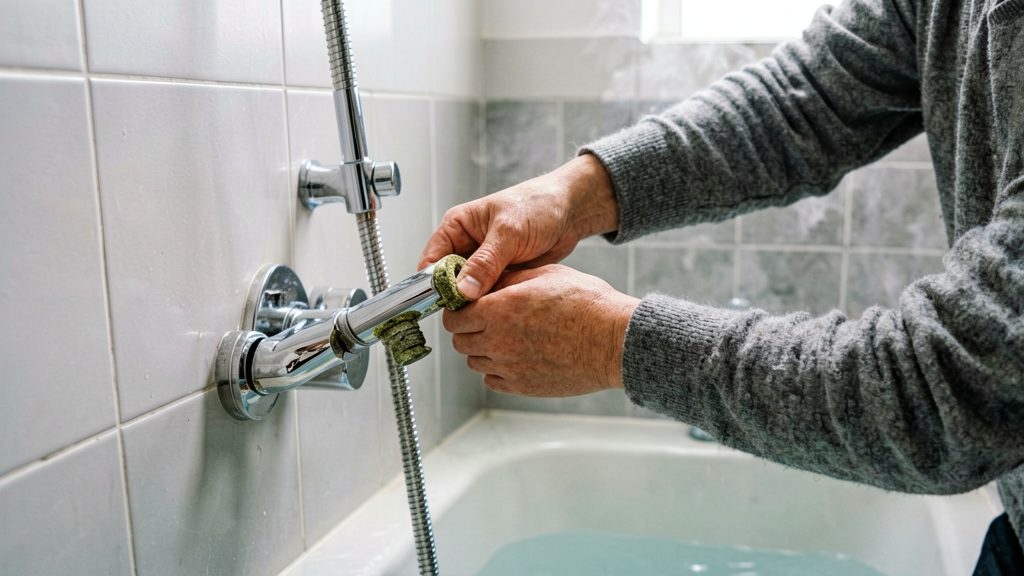
Low shower pressure usually comes from one of a few causes: a restricted showerhead, a worn or clogged valve cartridge, a partly closed main shut-off valve, competing water use elsewhere in the home, or deposits narrowing old galvanized pipes. Whether the weak flow is limited to the shower or affects the whole house is the first clue to which cause to check.
Why is my shower water pressure low?
Main causes of weak flow
| Cause | Typical pattern | Source |
|---|---|---|
| Partly closed main shut-off valve | Restricted flow throughout the home | This Old House (2026) |
| Competing demand from irrigation or other water use | Weak flow while other water is running | City of Dallas, Oregon |
| Clogged internal parts of a low-flow showerhead | Weak flow at the showerhead | City of Dallas, Oregon |
| Worn or faulty valve cartridge | Low hot-only or cold-only flow, or low flow at both tub spout and showerhead on Moen PosiTemp valves | Moen |
| Internal deposits in galvanized pipes | Gradual restriction of flow | City of Dallas, Oregon |
Check the shut-off valve and competing demand first, since they cost nothing to test. Showerhead and cartridge problems usually need a closer look at the fixture itself.
Mixing valve cartridge position in the flow path
In a typical shower, hot and cold water are combined inside the valve body and its mixing valve cartridge before reaching the shower arm and showerhead. A restricted cartridge can reduce flow at the tub spout and showerhead, or cause weak flow at a particular temperature setting; the pattern depends on the valve and the fault.
Deposits and corrosion in galvanized pipes
Galvanized pipes can corrode from the inside. Deposits build up and narrow the passage, which restricts flow (City of Dallas, Oregon). Because this narrowing develops gradually, weak flow may worsen over months rather than appear suddenly, and it can affect several fixtures rather than only the shower.
Whole-house causes
Pressure problems across the whole house can involve plumbing leaks or the pressure-reducing valve.
Is only the shower affected?
Compare the shower with the other fixtures before anything else. Open the kitchen tap and a bathroom basin tap, then the shower, and judge the flow at each. Weak flow at one fixture points to a local restriction. Low flow at every tap suggests the cause lies upstream, in the supply or the whole-house plumbing.
Test the other fixtures
Run each tap separately and note how strongly it flows. Compare like with like: test the hot side of the shower against a hot tap, and the cold side against a cold tap.
Reading the flow pattern
| Pattern | What it suggests |
|---|---|
| Only the shower is weak; other taps run normally | A local restriction at the shower |
| Shower and tub spout are both weak, but other taps are normal | A problem in the shower valve, not the supply |
| Only the hot side is weak at the shower and taps | A hot-side issue |
| Every tap and fixture is weak | A whole-house cause, such as the supply or a pressure-reducing valve |
Signs of a supply-side problem
Weakness across the whole house, especially when it appears suddenly, points to the supply side.
Check and clean the showerhead
Start by isolating the showerhead.
Removing and flushing the showerhead
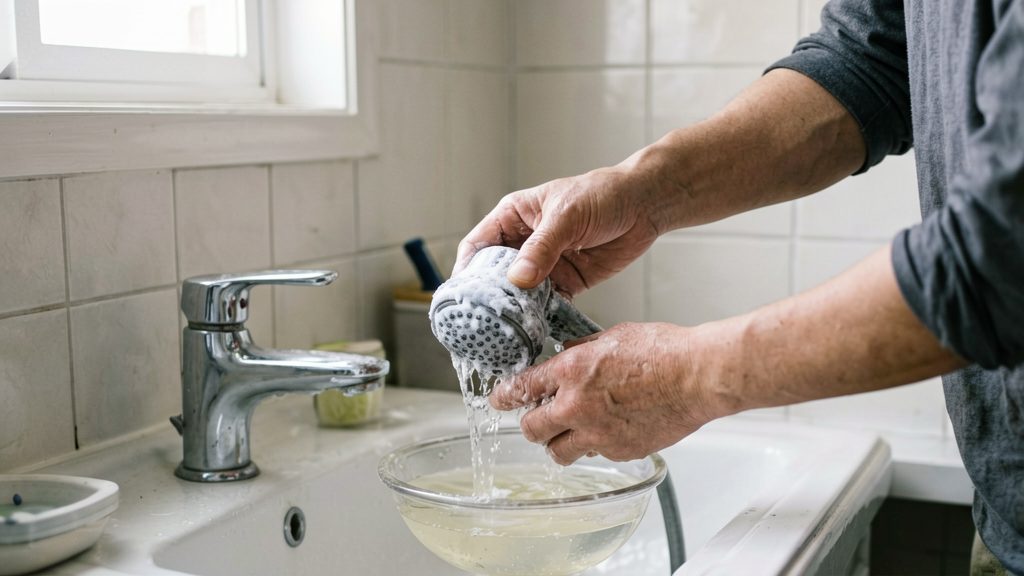
Unscrew the showerhead from the arm by hand, wrapping a cloth around the nut to protect the finish, and use an adjustable wrench only with padding if it is stuck. Look inside the outlet holes and the flow restrictor, if one is fitted. Internal parts of low-flow showerheads can become clogged, and removing and flushing the fixture can help restore water flow, according to the City of Dallas, Oregon.
Follow the manufacturer’s instructions for flushing the showerhead and clearing mineral deposits. Use only cleaning tools and methods approved for its finish and nozzles. An overnight soak in white vinegar is a common descaling method described by This Old House (2026). Finishes can react to acids, so check the manufacturer’s cleaning instructions before soaking.
Testing flow at the arm
With the showerhead removed, open the shower valve and observe the water flowing out of the shower arm. Moen’s PosiTemp troubleshooting guide recommends this test when the shower has no flow. Good flow at the arm means the restriction sits in the showerhead, so cleaning or replacing it is the fix. Weak flow at the arm points elsewhere, such as the valve or the supply pipe, and needs further diagnosis.
Replacing a showerhead that still restricts flow
If flow stays weak after cleaning, or the arm flows well but the head does not, replace the showerhead. WaterSense-labeled models use no more than 2.0 gallons per minute and are independently certified for performance, including spray force and coverage, according to the U.S. Environmental Protection Agency (2023). Choosing a labeled model helps you judge performance rather than relying on the flow number alone.
Compare hot and cold flow
Testing hot and cold flow separately shows which supply path is restricted. If only one side is weak, the fault is most likely in the mixing valve or the supply branch that feeds it. If both temperature settings produce weak flow, compare other fixtures and test flow with the showerhead removed before distinguishing a showerhead restriction, a valve problem, or an upstream supply issue.
Run each side on its own
- Set the shower handle fully to hot and run the shower. Note the flow at the showerhead and at the tub spout if your bath has one.
- Repeat with the handle fully on cold.
- Compare both results with a hot tap and a cold tap elsewhere in the home.
A hot-only test that shows weak flow does not by itself prove a water-heater fault. Consult a plumber to diagnose the cause.
Read the pattern
| Pattern | What it points to |
|---|---|
| Weak flow on hot only | Restriction on the hot side of the valve or its supply |
| Weak flow on cold only | Restriction on the cold side of the valve or its supply |
| Weak flow at both tub spout and showerhead | Restriction inside the valve path serving both outlets |
Moen PosiTemp 1222 cartridge
Moen’s guidance for PosiTemp valves recommends replacing the 1222 cartridge when flow is low on hot only, low on cold only, or low at both the tub spout and showerhead. Before ordering a part, confirm your valve is a PosiTemp and check the cartridge number against the label or the manufacturer’s instructions. Shut off the water supply before removing the cartridge, and follow the manufacturer’s steps for removal and reinstallation.
Check valves and competing water use
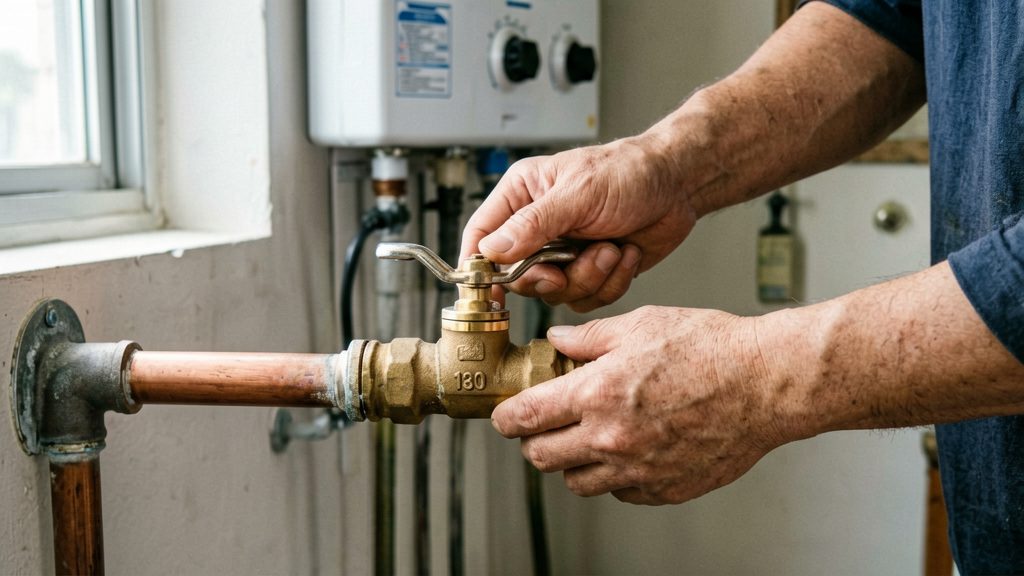
Before you look at the showerhead, confirm that the main shut-off valve feeding the house is fully open. A partially closed main restricts flow throughout the home, including after plumbing maintenance (This Old House, 2026-04-14). If weak flow shows up at several fixtures, not just the shower, this is the first thing to check.
To check the main valve, find where the water line enters the house, often near the water meter or in a utility area. Turn the handle slowly to its fully open position and stop at the stop point without forcing it. A valve that has not been moved for a long time may leak or fail when turned, so call a plumber if it is stiff, leaks, or will not open fully.
Testing for competing demand
Water used elsewhere in the home can reduce shower flow. Running irrigation while using water indoors can contribute to weak flow, so the shower should be checked when other water uses are off (City of Dallas, Oregon). A simple sequence:
- Pause any irrigation system and wait until it has stopped.
- Close taps elsewhere and make sure the washing machine and dishwasher are not filling.
- Run the shower alone and note how strong the flow is.
- Restart each other use one at a time, checking the shower each time, to see which one reduces flow.
The washing machine and dishwasher draw from the same supply while they fill. A shower run during a fill cycle can feel weaker than the same shower run between cycles.
If the shower stays weak with the main fully open and other water uses off, the cause lies outside this check.
Measure your home’s water pressure
Measuring static water pressure at an outdoor hose bib shows how strong the supply is before any water flows through indoor fixtures. Attach a pressure gauge to the bib and take the reading with all other fixtures and water-using appliances switched off, so the needle reflects supply rather than demand (This Old House, 2026-04-14).
- Disconnect any hose from the outdoor bib and screw a pressure gauge onto the threaded outlet.
- Turn off every indoor tap, toilet supply and water-using appliance, including washing machines, dishwashers and any irrigation system.
- Open the outdoor bib fully and read the gauge once the needle stops moving.
- Close the bib, remove the gauge, and record the reading with the date so you can compare later results.
There is no single ideal pressure that suits every home, so no universal target applies. Compare your reading with your own earlier readings and with guidance from your local water provider.
When should you call a plumber?
Call a licensed plumber when low pressure affects the whole house and the main shut-off valve is already fully open.
| Symptom | Likely area | Next step |
|---|---|---|
| Low pressure throughout the house, main valve fully open | Supply, main valve, or pressure-reducing valve | Call a licensed plumber |
| Sudden drop to almost no flow | Possible broken water line | Call a plumber promptly |
| Persistent low pressure with visible leaks, water stains, or an unexplained rise in water bills | Possible leak in the plumbing | Contact a plumber |
Pressure-reducing valve problems
The Town of East Longmeadow, Massachusetts advises consulting a plumber before adjusting that valve. Sustained water pressure above 80 psi can damage household plumbing and fixtures, so a plumber should check readings before any change is made. Replacing the valve is work for a licensed plumber, not a standard DIY task.
Suspected corroded pipework
Corrosion inside galvanized pipe is not visible, often because it sits behind walls, so you cannot confirm it visually. If low pressure persists alongside the symptoms in the table, ask a plumber to assess the pipework rather than replacing fixtures that are not at fault.