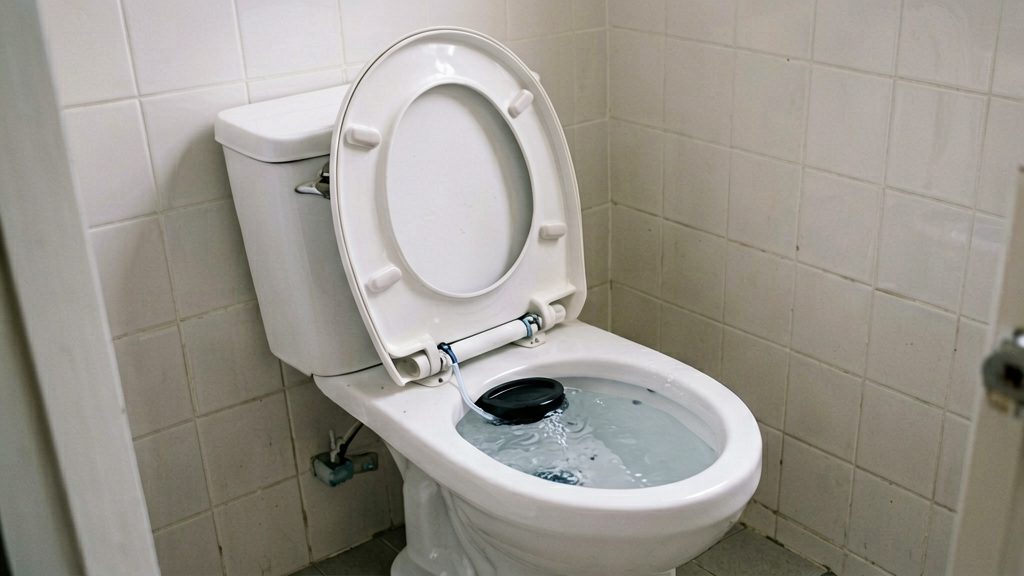
A normal toilet tank refill takes about 30 seconds to 2 minutes after a flush, according to House Digest (2023). Published guidance varies somewhat, and none of these figures comes from a manufacturer, so treat the range as a rough benchmark rather than a specification. If your tank takes well beyond the upper end, or keeps filling after the water stops moving, timing the refill will show whether it is actually slow.
How long should a toilet tank take to refill?
Other published guidance gives shorter and longer windows: 30 to 60 seconds, 45 to 90 seconds, and up to 2 minutes. Because these differ, compare your tank with its own baseline. Time it once before a problem starts, if you can, and note the result.
To time a refill with a stopwatch:
- Confirm the tank is full and still. Wait until no water is moving in the tank or bowl.
- Flush a normal full cycle, not a short partial one. The refill length depends on how much water left the tank.
- Start the stopwatch when you release the handle.
- Stop it when the sound of incoming water ends and the tank stops filling.
- Repeat the test at least three times and record the average of the results.
Compare the average with the ranges above. A result that is consistently at the top of the range or beyond it suggests the tank is slow. A single unusually long flush does not on its own indicate a fault.
Is the shut-off valve fully open?
A partly closed shut-off valve is a common reason a toilet tank refills slowly, and it is quick to check. The valve sits in the supply line that feeds the toilet, and even a partial closure cuts the water flow to the fill valve. Sediment can also build up inside the valve and restrict flow, even when the handle appears open.
Locate the supply valve
Look behind the toilet, near the base of the wall, for a small oval or round handle on a short pipe running from the wall to the tank. Some installations place it beside the toilet or under the sink. The valve is usually a quarter-turn or multi-turn handle, and it may be chrome, brass, or plastic.
Open the valve fully
- Place a hand on the handle and turn it counterclockwise until it stops. Do not force it past the stop.
- Flush the toilet, then time how long the tank takes to refill.
- Compare the result with the usual range.
According to Lee Company (May 2026), turning the valve counterclockwise until it stops and then retesting is the recommended check for a partly closed valve. If the refill is now within the normal range, the restriction was the valve. If the tank still fills slowly, the cause lies elsewhere, and the fill valve or the wider water supply needs checking.
Could a worn or clogged fill valve be the cause?
House Digest (2023) cites a faulty fill valve as the primary cause of a slow-filling toilet tank. The fill valve controls how quickly water enters the tank, so any restriction or wear inside it slows the refill.
How sediment restricts the valve
Mineral deposits and grit in household water can collect in the narrow passages of the valve body. This sediment narrows the opening the water passes through, so less water reaches the tank per second. Sediment can also build up in the supply line and shut-off valve, but the fill valve is the part where it directly limits flow into the tank.
If you know how long the tank took to fill when it was new, use that as your baseline.
Fill valves older than about seven years
House Digest (2023) notes that fill valves older than about seven years may perform worse because of wear. Treat the age as a rough guide rather than a fixed service life. A newer valve can fail, and an older one can still work. If you do not know when the valve was installed, do not assume it is new.
Signs that point to a failing fill valve
| Observation | What it suggests |
|---|---|
| Slow refill in one toilet while other fixtures fill normally | A problem local to this tank, such as the fill valve or sediment in its body |
| Slow refill on a valve older than about seven years | Wear is a likely contributor |
| Slow refill at several fixtures | Low whole-home pressure, often tied to a failing pressure-reducing valve or the main line |
Lee Company (2026) lists a worn fill valve among the common causes of slow filling, alongside partially closed supply valves, leaky flappers and kinked or corroded supply lines.
Can a leaking flapper slow the refill?
Yes. The flapper is the rubber seal at the bottom of the tank that holds water back until you flush. When it wears or warps, water seeps from the tank into the bowl even when the toilet is idle. The fill valve then has to replace that lost water on top of the flush volume, so the tank takes longer to refill.
How to run a dye test
A dye test shows whether water is leaking from the tank into the bowl. Lee Company (2026) describes this method:
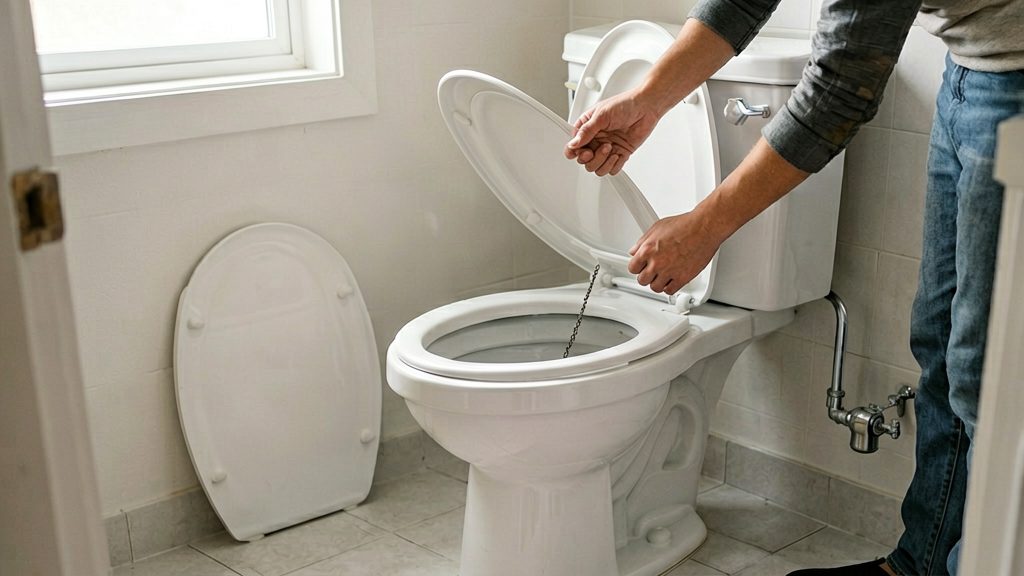
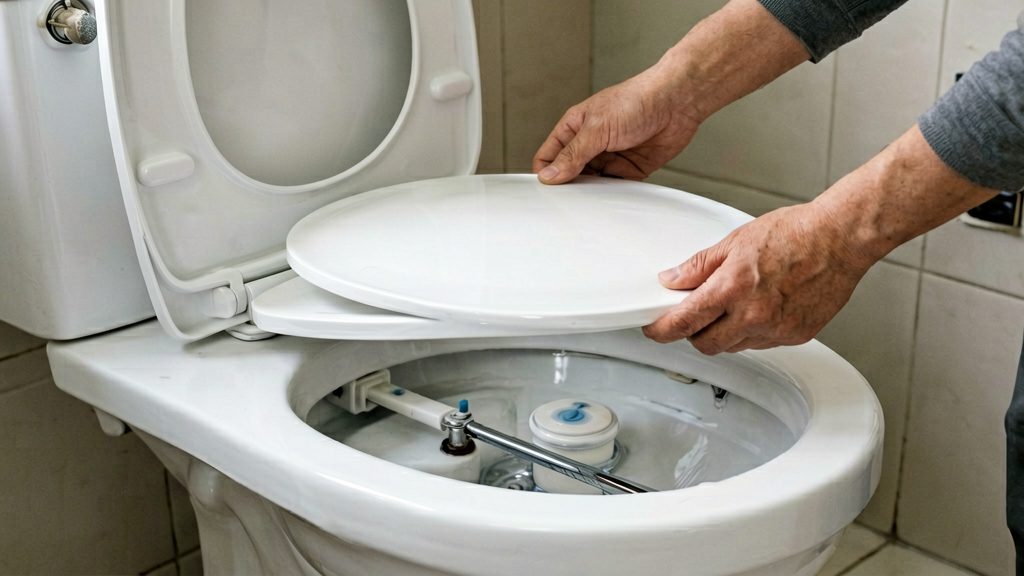
- Remove the tank lid and set it aside.
- Add about 10 drops of food coloring to the tank water.
- Wait 10 to 15 minutes without flushing.
- Check the bowl. If colored water has appeared there, the flapper is leaking.
What to do if the color reaches the bowl
If colored water appears in the bowl, replace the flapper. Flapper designs differ between toilet makes and models, so check the existing flapper’s markings or the toilet’s model number before buying a replacement. Follow the instructions supplied with the new flapper.
If the bowl stays clear after 10 to 15 minutes, a leaking flapper is unlikely to be the cause of the slow refill, and the supply valve or fill valve should be checked next.
Check the supply line and water pressure
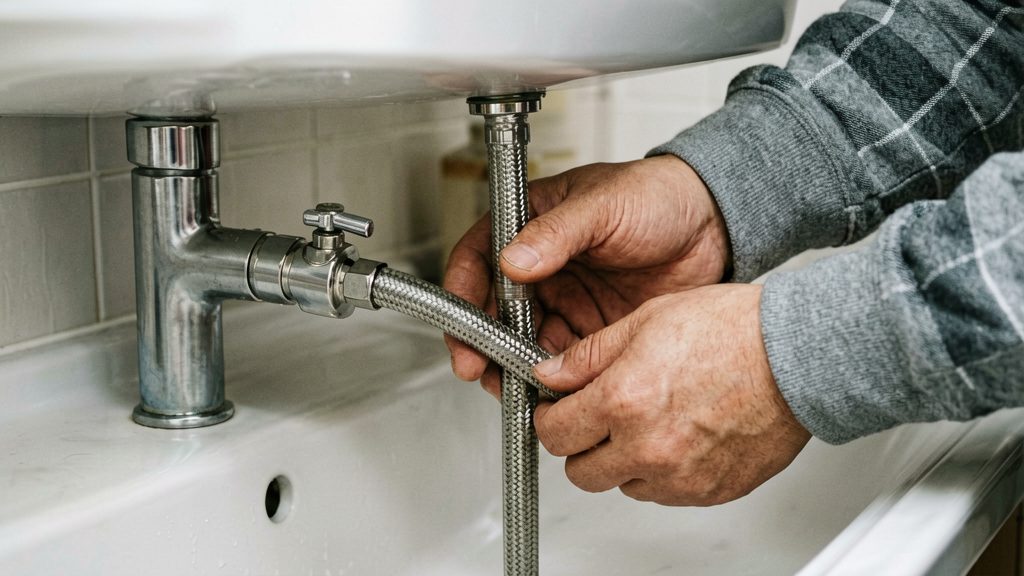
A kinked or corroded flexible supply line, the braided or plastic hose that runs from the wall shut-off to the fill valve, is one possible cause of a slow refill in a single toilet. Follow the hose from the wall to the tank. Look for a sharp bend or kink that narrows the passage, and for rust, crusty deposits or drips at the fittings. A kinked hose can be straightened or replaced. A corroded hose restricts flow and should be replaced with one of the same length and fittings.
If the hose looks sound, check the pressure. Lee Company (2026) cites normal residential water pressure as 45–60 PSI. To measure it, fit a pressure gauge to an outdoor hose bib or utility tap, make sure no water is running inside the house, and read the static pressure. A reading taken while taps are open will be lower than the resting value.
Interpret the result by how many fixtures are affected:
- Only one toilet fills slowly: the problem is local to that fixture. Check the fill valve, the flapper, the shut-off valve and the supply hose.
- Several fixtures are slow and the gauge reads below 45 PSI: Lee Company (2026) links low whole-home pressure, often caused by a failing pressure-reducing valve (PRV), to slow filling. Suspect the PRV or the main line, and contact a licensed plumber or your local water utility. Replacing a PRV is not a simple home task.
How do I clean or replace a fill valve?
Sediment can restrict flow through the fill valve body, so cleaning the valve is worth trying before replacing it. House Digest (2023) describes the cleaning sequence below, which starts with shutting off the water and draining most of the tank.
- Shut off the water. Close the supply valve behind the toilet, then flush to drain most of the tank. Remove the cap on top of the fill valve.
- Flush the valve. Hold a cup upside down over the valve opening and briefly turn the water on. The cup catches the spray while the flow pushes out debris. Shut the water off again.
- Set the float level. After reassembly, adjust the float so the valve shuts off about ½ to ¾ inch below the top of the overflow tube, according to House Digest (2023).
If cleaning does not restore a normal fill, replace the valve. Use the same shut-off and drain steps, unscrew the old valve from the tank, and fit the new one following its instructions. Then set the float as described above. Replacement valves are often quoted at about $10–20 in Lee Company (2026), a contractor blog figure rather than a manufacturer price, so check your local prices before buying.
When should I call a licensed plumber?
Call a licensed plumber when a slow refill survives the basic DIY fixes, when several fixtures slow down together, or when the fault is in a pipe or somewhere you cannot reach safely. Refill timing varies by source, so treat these as signs to act rather than exact cut-offs.
Slow refill that persists after DIY checks
Once you have fully opened the supply valve by turning it counterclockwise until it stops, tested the flapper with a dye test, and cleaned or replaced the fill valve, a refill that still runs long needs a professional diagnosis.
Pressure-reducing valve suspected
If the toilet is slow and other fixtures are too, suspect the pressure-reducing valve (PRV) or the main line, according to Lee Company (2026). A whole-house pressure reading well below the normal range points away from the toilet itself. Replacing a PRV means working on the main supply, which usually requires shutting off the whole house and handling pipework under pressure. Check local rules, since many areas require a licensed plumber for main-line work.
Blocked roof vent
Service Experts names a blocked roof plumbing vent as a possible cause of slow refill. This claim comes from a single company blog and is not confirmed elsewhere, so treat it as something to check, not a confirmed cause. The roof vent is outside the bathroom, so inspecting it means working from the roof. Clearing a blockage there is a job for a licensed plumber or roofer.
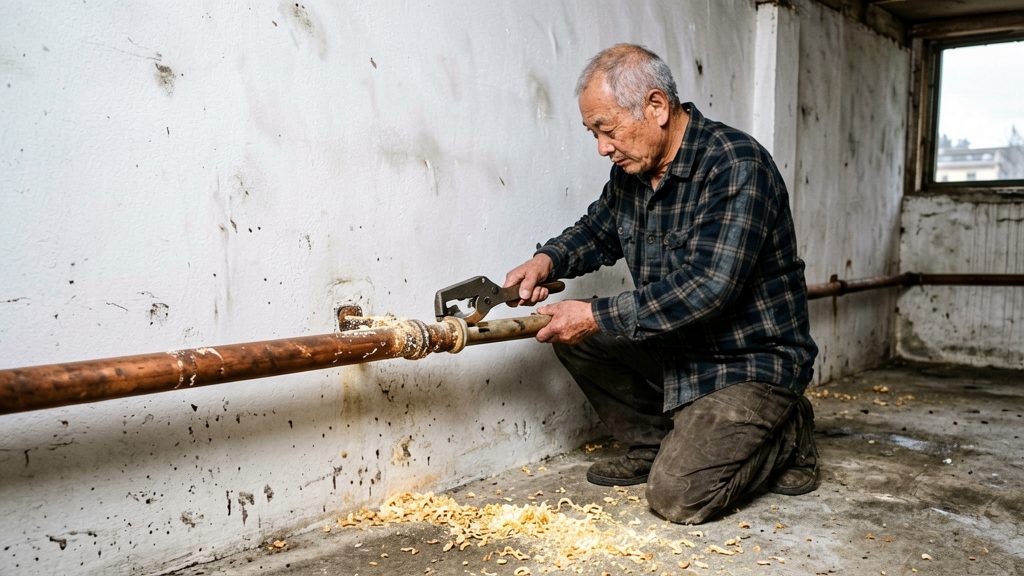
Leaking or blocked supply pipe
Service Experts states that a leaking or blocked supply pipe is a job for a licensed plumber. Any visible drip from the pipe itself, or water pooling around it, should be handled by a professional rather than patched.