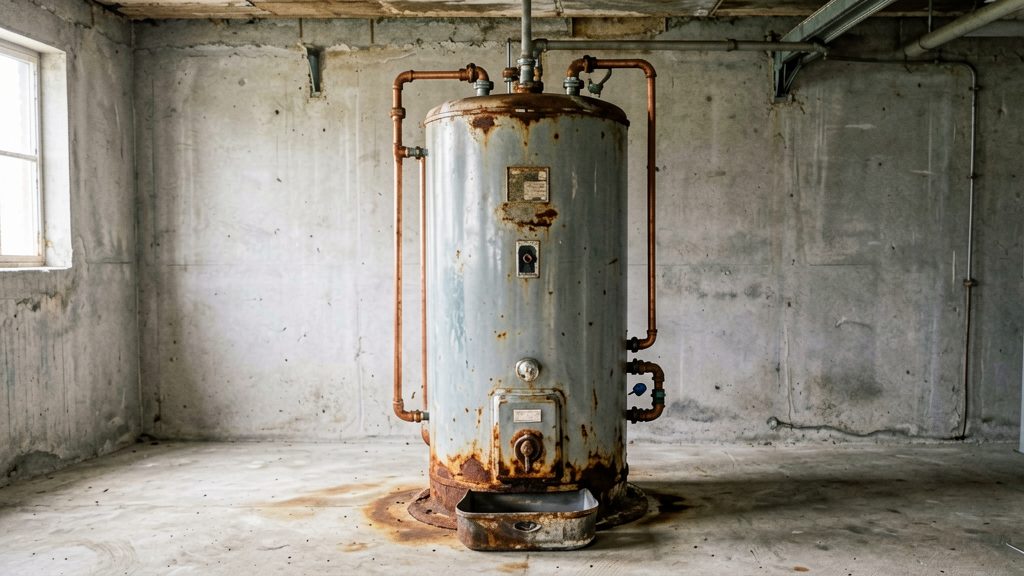
A conventional water heater in Canada is usually treated as reaching the end of its planning horizon around ten years of age. Age is a guide, not a guarantee of failure or of remaining life.
How long does a water heater last in Canada?
Ten-year rule of thumb. Home inspectors commonly use about 10 years as a working benchmark for a water heater’s age, according to InspectAPedia (2026). A unit reaching that age does not have to be replaced automatically. It is a reason to inspect it more closely for leaks, corrosion at the base and any change in hot water supply, and to plan for a possible replacement.
Units still in service after twenty years. Water heaters about 20 years old are still operating, according to InspectAPedia (2026). Age alone does not show whether a unit is safe or near failure. Condition matters more: check for moisture around the base, rusty or metallic-smelling water, and noises from the tank.
Finding the manufacture date. The manufacture date is normally recorded on the data label, the rating plate attached to the unit that lists its model and serial numbers. Read the serial number and check the manufacturer’s instructions or website for how that brand encodes the manufacture date, since coding systems differ between manufacturers. If the label is missing or unreadable, contact the manufacturer with the model and serial numbers, or ask a licensed plumber to confirm the age.
Tank vs tankless: lifespan compared
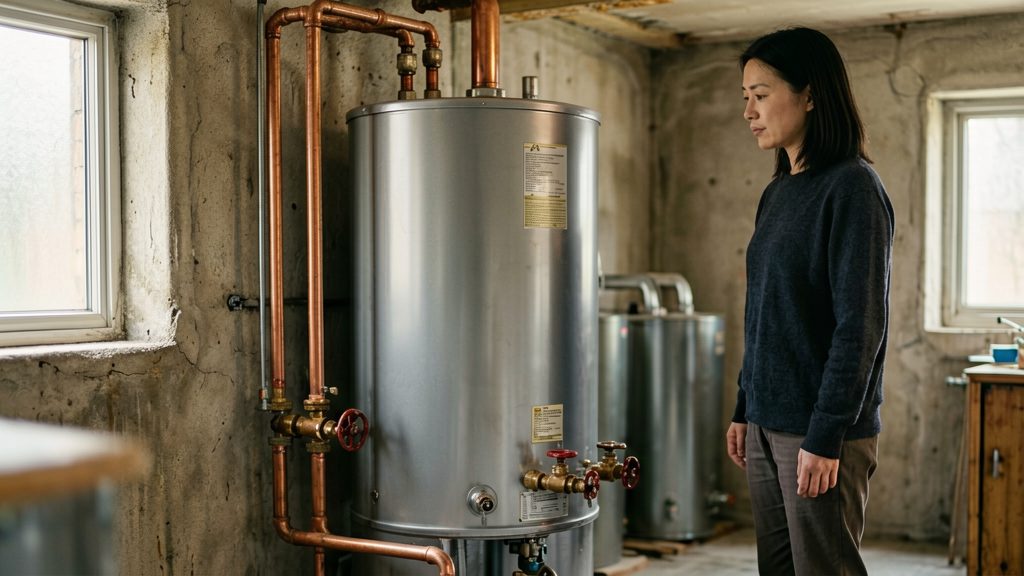
A conventional tank water heater typically lasts about 8 to 12 years, while a tankless unit typically lasts about 15 to 20 years. InspectAPedia reports tankless units lasting about 18 to 20 years, and gas and oil tank units about 8 to 12 years. These are typical ranges, not guarantees, and a specific unit can fail earlier or run longer.
| Unit type | Typical lifespan |
|---|---|
| Conventional tank | About 8 to 12 years |
| Tankless (general) | About 15 to 20 years |
| Gas and oil tank units | About 8 to 12 years |
The tank and tankless ranges come from HVACNearMe (2026), and InspectAPedia (2026) gives about 8 to 12 years for gas and oil units and about 18 to 20 years for tankless units. Mr. Rooter Plumbing (2026) reports that conventional tanks in Edmonton average about 8 to 12 years and that tankless models often exceed 20 years. The tankless figures vary between sources, so treat 15 to 20 years as a planning range. These figures come from contractor and inspector publications rather than government or standards bodies.
For planning, it helps to budget for a tank replacement somewhere in the 8 to 12 year range.
A tankless unit’s longer range means fewer replacement cycles over the life of a home. It does not remove the need to follow the manufacturer’s maintenance schedule.
What shortens a water heater’s life?
Five conditions can push a unit below the typical lifespan: hard water, little maintenance, an undersized tank, poor installation, and a cold or drafty location. Each one can shorten the unit’s life.
| Condition | How it shortens life | What to check |
|---|---|---|
| Hard water | Causes sediment and corrosion inside the tank, according to Mr. Rooter Plumbing (Edmonton) (2026) | Ask your water utility for the local hardness level, since it varies by area |
| Undersized tank | Listed as a condition that can shorten life (HVACNearMe.ca, 2026) | Compare the tank’s rated capacity in the manufacturer’s specifications with your household’s peak hot-water use |
| Poor installation | Listed as a condition that can shorten life (HVACNearMe.ca, 2026) | Follow the manufacturer’s installation instructions, or have a licensed plumber install the unit |
| Cold or drafty location | Listed as a condition that can shorten life (HVACNearMe.ca, 2026) | Install the unit in a space with a stable temperature, not an exposed or draughty area |
Hard water and sediment
Hard water carries dissolved minerals into the tank, and the sediment and corrosion it causes are linked to shorter tank life. Because hardness differs from one water supply to another, a unit in one home can age faster than the same model in another. Check your local hardness level before assuming a unit will reach the typical range.
Undersized tanks
A tank that is too small for the household runs out of hot water during heavy use, such as back-to-back showers or running a washing machine and dishwasher together. If the tank is undersized, it is worth comparing its capacity with actual demand before replacing it, because the sources name an undersized tank as a factor that shortens life without specifying how much.
How can you make a hot water tank last longer?
Three routines slow the wear inside a tank: flushing out sediment, inspecting the anode rod, and keeping the thermostat at a sensible setting. Each one targets a different cause of corrosion or scale.
Flush the tank to remove sediment
Minerals and debris settle on the bottom of the tank as sediment. According to InspectAPedia (2026), regular flushing removes sediment and extends tank life. The manufacturer’s manual is the reliable guide for how often to flush.
For an electric tank:
- Switch off the heater at the breaker.
- Close the cold water supply valve on the inlet pipe.
- Attach a garden hose to the drain valve near the base and run the other end to a floor drain or outdoors. Expect hot water.
- Open a hot tap elsewhere in the home so air can enter the system.
- Open the drain valve and let the water run until it comes out clear.
- Close the drain valve, remove the hose, and open the cold supply. Wait until the tank is full and the hot tap runs steadily before you restore power. Energising elements in an empty or partly filled tank can damage them.
Gas units involve gas controls and combustion safety. Do not follow these steps on a gas-fired unit. Refer to the manufacturer’s manual or call a qualified technician.
Check and replace the sacrificial anode rod
The sacrificial anode rod is a metal rod, usually screwed into the top of the tank, that corrodes so the tank lining does not. According to InspectAPedia (2026), it may need replacing every few years, depending on water chemistry. The interval is not fixed, so inspect it rather than replacing it on a set date.
To check it, turn off power and water supply, then relieve pressure by opening a hot tap. Let the water cool first, since tank water can be scalding, and leave this job to a qualified technician on a gas-fired unit. Confirm there is enough headroom above the tank to withdraw the rod before you start. Then unscrew the rod with a socket wrench and look for heavy pitting or a thinned core. Replace it with a rod that matches your tank model, as specified in the manual.
Keep the thermostat setting moderate
Higher temperature settings may shorten tank life and increase scale, according to InspectAPedia (2026). Lowering the setting reduces this stress, but it must still deliver enough hot water for your household. Check the manufacturer’s label or manual for the recommended setting rather than relying on a number from memory. Adjust the dial in small steps and observe hot water performance over several days.
The thermostat also wears out over time, as do the heating element and drain valve, according to Mr. Rooter Plumbing (Edmonton) (2026). If the setting no longer holds or the water temperature drifts, have a licensed plumber assess the control.
Signs your water heater is failing
A tank nearing the end of its service life usually shows decline through performance, sound and water quality before it fails outright.
Hot water running out sooner or rising energy bills
Hot water that runs out earlier than it used to, and energy bills that climb without a change in use, are both listed as warning signs of a failing tank (HVACNearMe.ca, 2026). Check whether the thermostat has been raised, since higher settings may shorten tank life and increase scale (InspectAPedia, 2026).
Rumbling or popping noises
Rumbling or popping sounds usually come from sediment settled at the bottom of the tank (HVACNearMe.ca, 2026).
Rusty, metallic or rotten-egg smelling water
Rusty or metallic-smelling water is a listed warning sign of a failing tank (HVACNearMe.ca, 2026). Hot water with a rotten-egg smell can point to a corroded anode rod, the sacrificial component that protects the tank from corrosion (InspectAPedia, 2026). Compare the smell on hot and cold taps: if only the hot side smells, the water heater is the more likely source.
Repair or replace your water heater?
Three factors usually decide the question: the unit’s age, the type of fault, and whether the warranty still applies. Age gives a starting point, not a cutoff.
Age thresholds
- Under 7 years: HVACNearMe.ca (2026) suggests repairing a unit of this age that has a minor fault.
- 10 years or more: Age alone does not settle the decision.
- Between roughly 7 and 10 years: The sources give no firm threshold. Weigh the type of fault and the repair quote.
These thresholds come from trade and inspection publications, not from standards bodies or regulators.
Faults that favour replacement
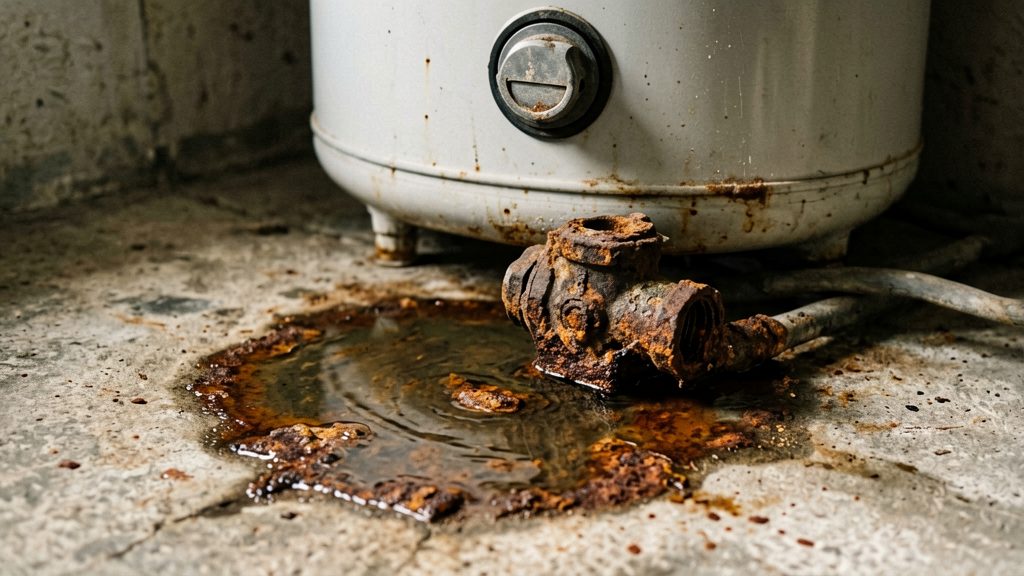
A tank leak on a unit aged 10 years or more points toward replacement, and so do several faults occurring together at that age (HVACNearMe.ca, 2026).
| Unit age | Fault | Suggested action |
|---|---|---|
| Under 7 years | Minor fault | Repair |
| 10 years or more | Tank leak | Replace |
| 10 years or more | Several problems at once | Replace |
Repairable parts are the ones that wear out over time: the anode rod, thermostat, heating element and drain valve (Mr. Rooter Plumbing (Edmonton), 2026). If the fault sits in one of these, a repair is the realistic option even on an older unit, provided the tank itself is sound.
Warranty length and exclusions
Residential tank warranties commonly run 6, 9 or 12 years. They usually cover leaks from rust or corrosion, but they exclude warranty exclusions such as scale-related failures. Improper installation or poor maintenance can void them (InspectAPedia, 2026). In hard-water areas, scale is the exclusion most likely to apply (Mr. Rooter Plumbing (Edmonton), 2026).
A longer warranty does not reliably indicate a longer-lived unit. InspectAPedia (2026) notes that this link is not firmly supported by data.
When should you call a licensed plumber?
Stop DIY work and call a licensed plumber or qualified technician when the job involves gas, the pressure relief valve, or a replacement that needs a permit. Each carries safety or legal consequences that a homeowner or tenant should not take on alone.
Gas-fired units. Burner, gas valve, gas line and flue work belongs with a qualified technician. Limit your own actions to visual checks and the warnings in the manufacturer’s manual. If you smell gas, leave the building without operating switches or creating flames, then call your gas utility or local emergency number from outside. Soot, scorching around the unit, or a flue that does not draw properly also mean you should stop and call a technician.
Pressure relief valve discharge. The temperature and pressure relief valve must be able to release water safely. Call a plumber if the valve weeps or drips continuously, or if its discharge pipe is missing, capped, reduced in size, or looped so water can trap in it. The discharge pipe should run downward to a safe drain or a visible location near the floor, as your local plumbing code and the valve maker’s instructions specify. Discharged water can be scalding, so avoid working on the valve while the tank is hot or pressurised.
Permits and inspections for replacements. A tank replacement can require a permit and inspection, particularly when gas piping, venting, the electrical supply or water connections change. Requirements are set by your local building or plumbing authority and vary by municipality, so confirm them before you buy equipment. Tenants should obtain the landlord’s approval in writing first. When requesting a quote, ask whether it includes the permit and the inspection.