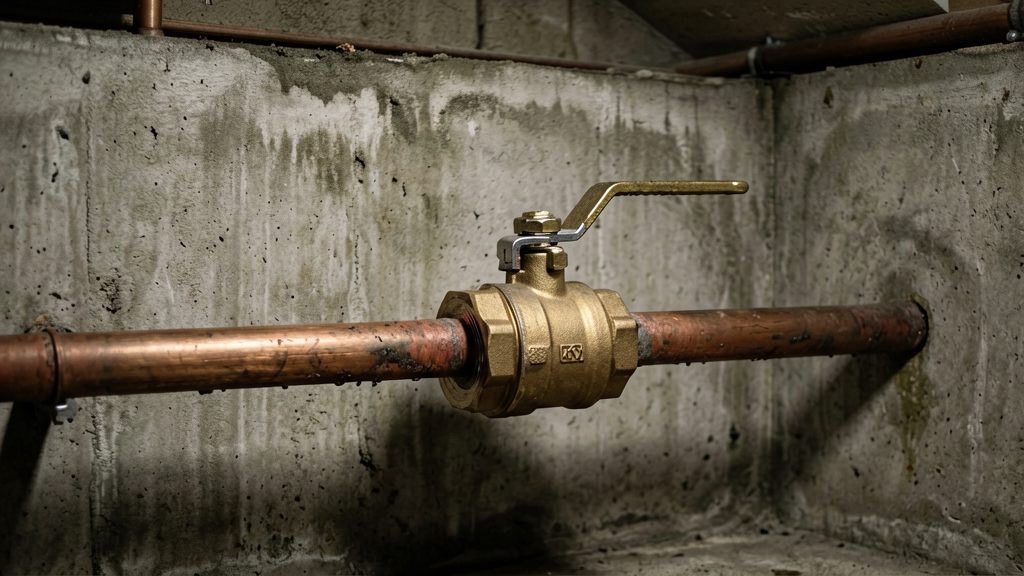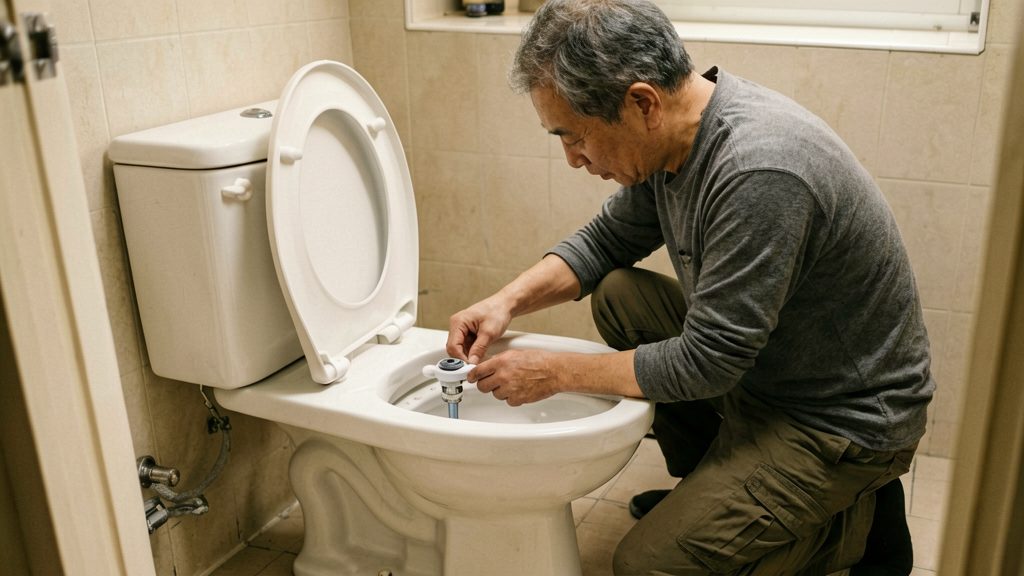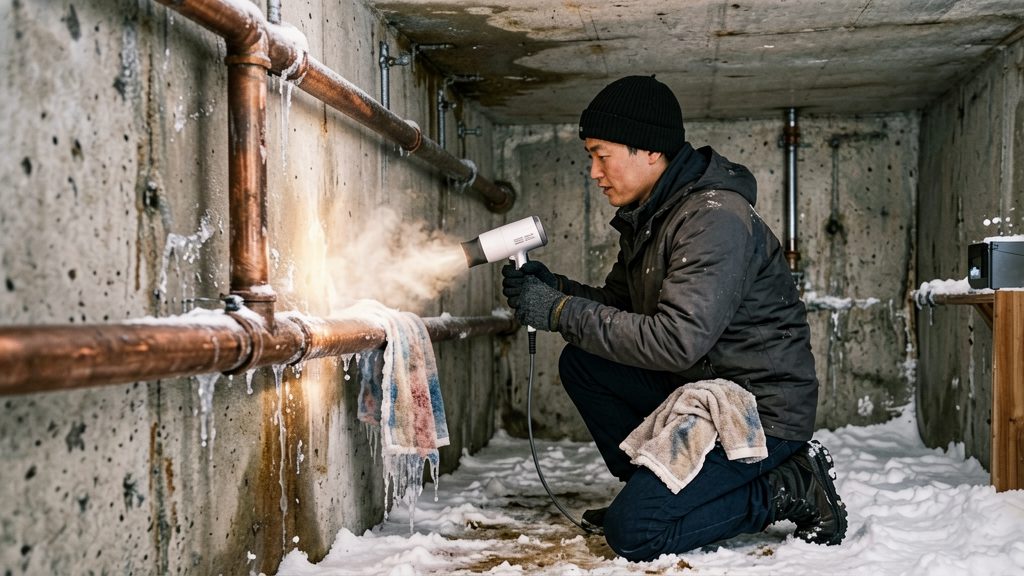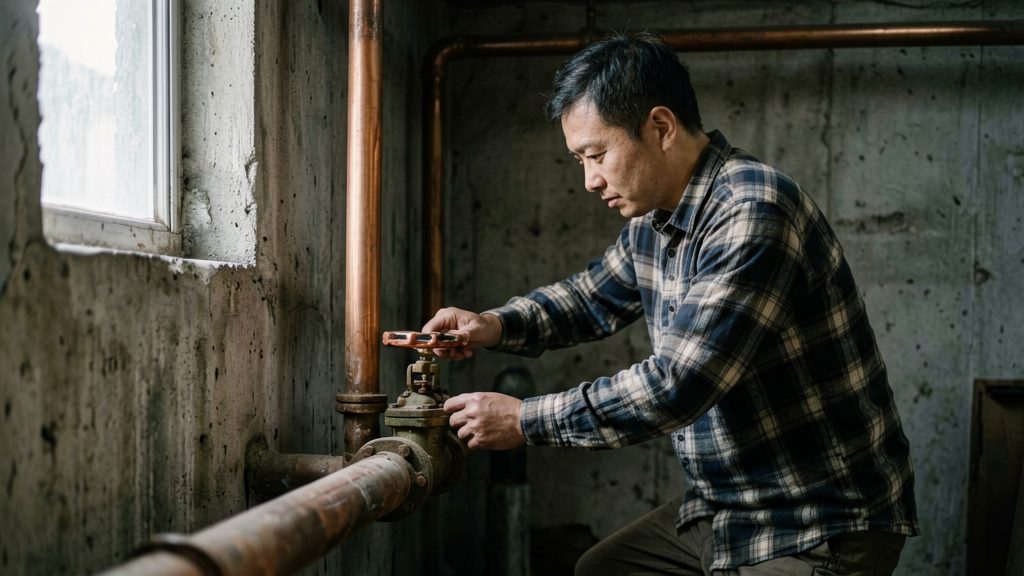
The main shut-off valve is usually where the water service line enters the home, on the foundation wall or in the basement, just before the water meter. Municipal guidance from Toronto, Edmonton and Calgary places the valve where the water line enters the home, though the exact spot varies from house to house. Start in the basement or utility room, then look along the pipe that comes through the wall closest to the street-side supply line. The valve sits on that incoming pipe, not on the fixtures inside.
Where is the main water shut-off valve?
Typical position at the foundation wall or basement
Municipal guidance places the valve at the foundation wall or in the basement, close to the point of entry:
| City | Typical position |
|---|---|
| Toronto | On the foundation wall where the water pipe enters the home (City of Toronto, 2017) |
| Edmonton | In the basement, next to the water meter (EPCOR, 2026) |
| Calgary | Where the water line enters the home (City of Calgary, 2026) |
If the valve is not in one of these places, the house may have been altered or the supply may enter through a crawl space or utility room. Ask a plumber or your utility before assuming it is elsewhere.
Location relative to the water meter
The valve is on the supply side of the water meter, meaning on the pipe before the meter. Toronto places it just before the meter, and Edmonton specifies the pipe before the meter (EPCOR, 2026). If you find a meter, look at the pipe coming in from the street, not the one leaving toward the house. The valve may be a few centimetres or a few feet away, depending on the installation.
Identifying gate, ball and stop-and-waste valve types
Toronto describes its main shut-off as a stop-and-waste valve (City of Toronto, 2017). This type is designed to drain the water remaining in the pipe on the house side when closed. Gate and ball valves are other common types you may find on the supply line:
- Ball valve: a lever handle that moves through a quarter turn.
- Gate valve: a round wheel handle that turns several times.
Turning direction and the exact motion for each type are not confirmed by the municipal sources. The common convention is given below. Check it against your valve’s markings before turning it, and ask a plumber if the markings are unclear.
Calgary recommends checking the internal main shut-off valve once a year to confirm it still works (City of Calgary, 2026). Testing it when you do not need it is safer than discovering it is stuck during a leak.
How do you turn off the water at the main valve?
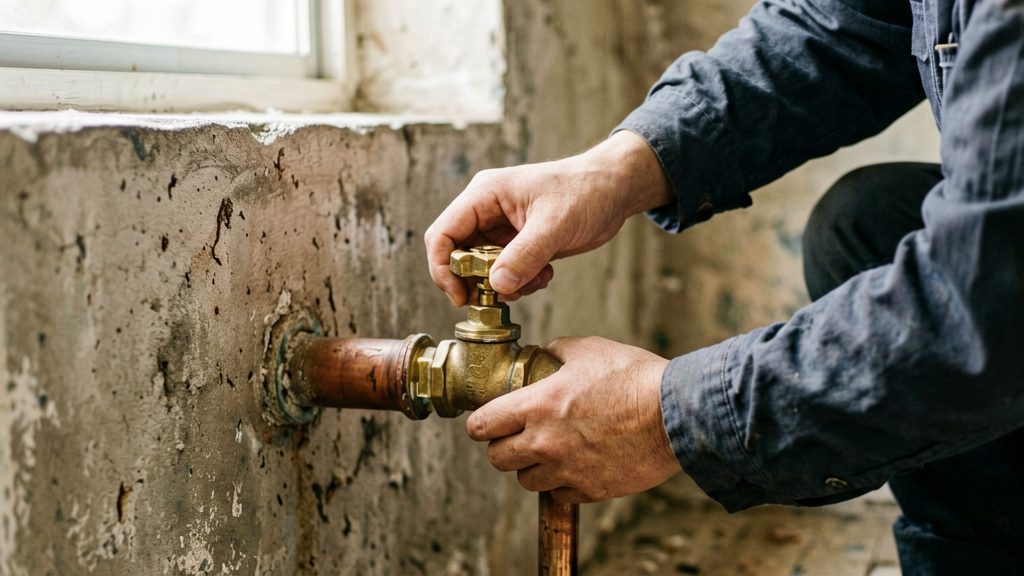
To shut off the water at the main valve, find the valve where the supply line enters the home and close it fully. If you cannot find it, follow the pipe from the meter back toward the point where it enters the building.
Turning direction and full closure
The turning directions below come from commercial plumbing guidance and are not confirmed by an official utility source. Check them against the markings and handle on your own valve.
- Quarter-turn ball valve: The lever usually closes with a quarter turn, commonly clockwise, but confirm on your valve’s markings. A lever across the pipe generally means closed, a lever along the pipe open.
- Multi-turn gate valve: Turn the handle clockwise until it stops. This takes several turns, not one.
Turn the valve until it reaches its stop, and do not reopen it while you work on the plumbing.
Quarter-turn ball valves versus multi-turn gate valves
Both types commonly close clockwise, but check your own valve, and they differ in how much movement is needed. A quarter-turn ball valve closes in one motion, so the position of the lever tells you whether it is open or closed. A multi-turn gate valve needs repeated turns, so count the turns or feel for the point where the handle stops. Because the two types move differently, identify which one you have before you start.
Confirming flow has stopped at a tap
Open a tap to check that the flow stops. This check comes from commercial plumbing guidance, not an official source. Leave it open until the flow stops, then close it. If water keeps running well after the pipes should have drained, the valve may not be fully closed: do not force it, and call a licensed plumber or your utility.
What if the main valve is stuck or leaking?
A main valve that will not close fully or drips from its body needs careful handling, not force. According to EPCOR (2026), if it leaks or sticks, you should hire a plumber, and call EPCOR first to have the water shut off at the curb stop.
Stuck valve
Do not force a stuck valve. This precaution comes from a US company page and is not confirmed by the Canadian utilities. Forcing it risks damaging the valve and causing a leak. If the valve resists, stop, and call a plumber. In Edmonton, EPCOR advises calling EPCOR first to have the supply shut off at the curb stop.
Packing nut leak
If water seeps from around the valve stem, do not try to repair the valve yourself. EPCOR advises hiring a plumber and calling EPCOR first to have the supply shut off at the curb stop. Elsewhere, call a licensed plumber.
Signs the valve needs a licensed plumber
Call a licensed plumber if you notice any of the following:
- The valve does not close fully, or the handle turns with no effect on flow.
- Water keeps flowing from the pipe after the valve is closed.
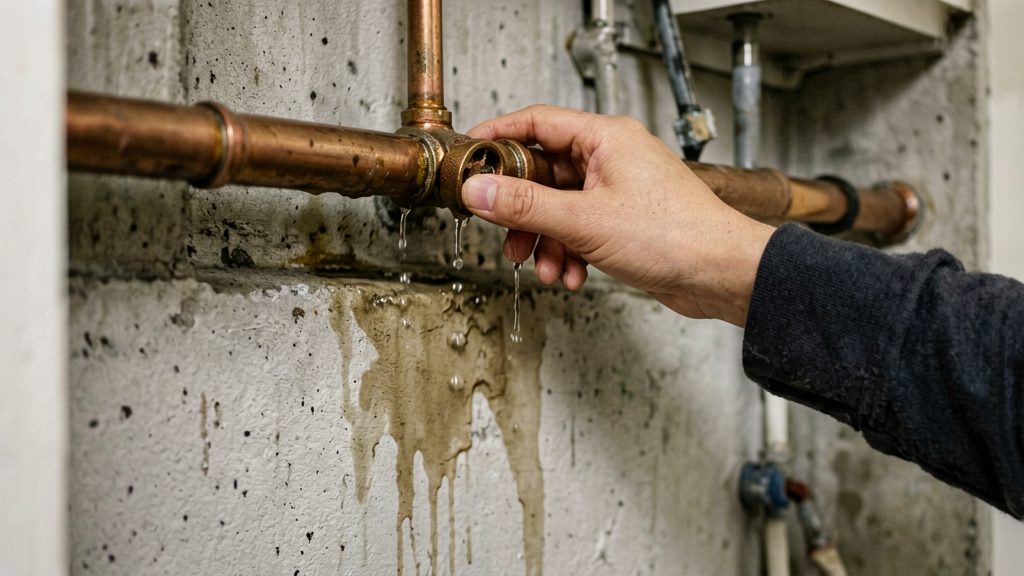
- Water leaks from the valve body, a joint, or the stem.
- The handle is cracked, broken, or seized.
In Calgary, the City advises that if the valve needs repair, a certified plumber can request a City shut-off at the property line. For an uncontrollable leak causing property damage, contact 311 (City of Calgary, 2026).
When to call your city or utility
Call your city or water utility when you cannot stop the flow from inside the home, or when the leak is between the property line and the house. In Toronto, the City can shut off the supply at the property line for a fee, according to the City of Toronto guidance, which is dated 2017 and may be out of date. Fees vary by municipality, so check your city’s current schedule before you call.
Locate the curb stop and keep it accessible
The curb stop is the valve at the property line where the municipal water main connects to the private service pipe. In Edmonton, EPCOR owns it. Keep it clear of obstructions, and do not pour a new driveway over it, according to EPCOR.
Plan the service visit and be home
Timing depends on your city:
- Toronto: Call 311. Online requests are not available. According to the City’s 2017 page (which may be out of date), staff should arrive within two hours, and someone must be home to let them in.
- Edmonton: Call EPCOR at 780-412-4500. A shut-off needs a site visit, which can take up to three business days, so it is not an instant emergency service.
- Calgary: For an uncontrollable leak causing property damage, contact 311, according to the City of Calgary.
Know who owns the pipe inside the property line
Ownership of the pipe between the property line and your home can vary by city; only Toronto’s rule is confirmed in the sources here. In Toronto, the homeowner owns the service pipe from the property line into the home, while the City owns the section from the watermain to the property line. A leak in your section is your repair responsibility, so you will need a plumber for it.
| City | Owner of the valve at the property line | How to request a shut-off |
|---|---|---|
| Toronto | City owns the section from the watermain to the property line | Call 311 (a fee applies) |
| Edmonton | EPCOR owns the curb stop | Call EPCOR at 780-412-4500; a site visit is required |
| Calgary | City controls the shut-off at the property line | A certified plumber can request it |
Confirm your local rules with your city, since the sources above do not cover every municipality.
Tenants and condo owners: who to call
Residents of multi-residential buildings should contact the building manager before shutting off water, according to EPCOR (2026). In shared buildings, the first call usually goes to the property manager, landlord, or board, not to the utility or city.
Contacting the building manager first
Before touching any valve, reach the building manager or management office. They can confirm where the building’s shut-off valves are and which valve controls your unit. Keep their emergency number in your phone or on a card near the front door so you can reach them quickly.
Landlord and tenant responsibilities
Your lease and the building rules usually set out who handles emergency repairs and who pays for them, but the outcome can depend on the case. Read them before a problem occurs and report any leak to your landlord as soon as you see it. If you disagree about responsibility or costs, contact your provincial tenant board or seek legal advice.
Condo and strata boards
Where pipes serve several units, the strata council or condo board is usually the body to contact for shared plumbing. The building’s governing documents set out which pipes belong to the building and which belong to each unit. Confirm this with the manager before you start work on any pipe.
Municipal and utility contacts
Tenants should confirm with the landlord before calling the utility, since the building owner usually has the authority to request the work.
Test your valve before an emergency
A main shut-off that has never been operated may not work when you need it. Routine checks confirm that the valve still moves, and a written record lets everyone in the household find it without searching.
Run an annual check
The City of Calgary recommends checking the internal main shut-off valve once a year to make sure it works (City of Calgary, 2026). Choose a calm moment, not during a leak, and operate the valve through its full movement. Note whether the handle or wheel turns freely and whether it moves without catching or grinding.
Record the valve’s location and condition
Write down where the valve is, what it controls, and its condition, then share the note with everyone in the home.
Keep the location record simple:
- The exact spot, with a photo and a clearly labelled tag or sketch
- The date of the last check and its result
- Whether the valve turns freely
- Any valve that will not fully close
Flag a valve that will not fully close
Mark a valve that will not fully close in your record and arrange service rather than testing it repeatedly.
After the water is off: next steps
Shutting off the main valve leaves water and pressure in the lines, so the work has three stages: drain the residual pressure, check every joint and fixture while the system is empty, and restore flow gradually. Each stage makes the next one easier to judge.
Drain the lines
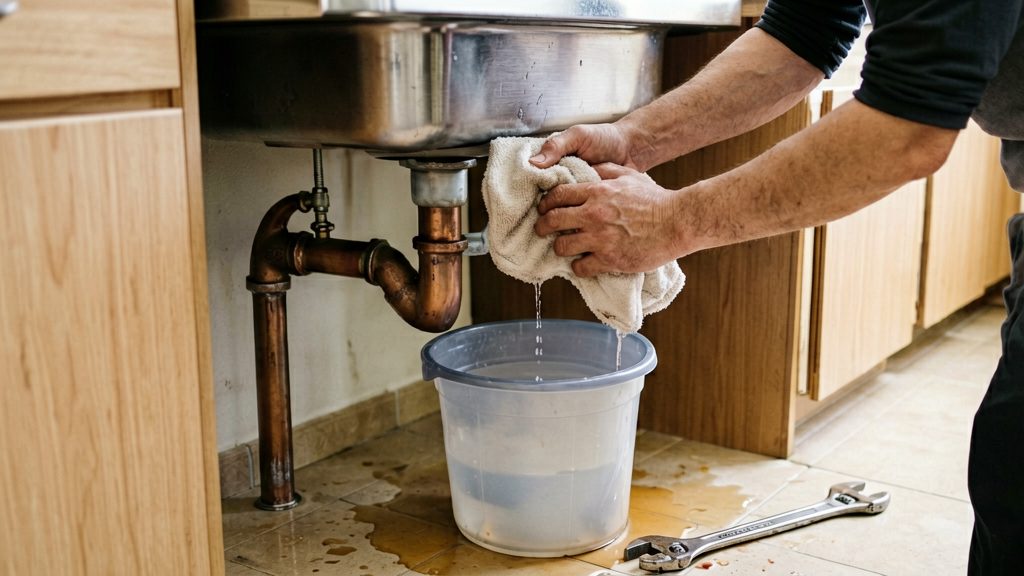
Open a tap at the lowest point of the home, such as a basement or ground-floor fixture. Leave it running until the flow stops. Then open a tap on an upper floor to let air into the system, so the water in the higher lines can drain. Keep a bucket and towels nearby for the water left in traps and fixture bodies.
Inspect joints and fixtures
With the lines drained, look for problems that pressure would expose later:
- Compression fittings and unions under sinks and at appliance connections, for drips, mineral crust or staining.
- Supply hoses and flexible connectors for bulges, cracks or brittle rubber.
- Tap and valve bodies, especially around the stem and handle, for moisture.
- Visible copper, PEX or PVC runs for cracks, kinks, scoring or discoloration.
- Floors and cabinet bases below fixtures, for damp patches or swelling.
Dry each joint with a towel before restoring flow. A leak that appears only under pressure will show itself once water returns, so keep the area under observation.
Restore supply slowly
Open the main valve gradually, not all at once. Then open a low tap and let water run until the flow is steady and free of sputtering. Close it and move to the next tap, working upward through the house.
Sputtering, hissing or rattling usually means trapped air in the lines. Keep the tap open until the noise stops and the flow runs clear. Repeat the check at each fixture before closing it.